
THE DAILY DERBY NOTE · Collecting & gifts
Derby glass misprints: the small mistakes collectors look for.
Most official Derby glasses are easy to find and inexpensive. A few are not, because something went wrong at the printer. If you are browsing a Black Friday sale, an antique mall or a relative’s cabinet this weekend, here is what to turn the glass around and check.
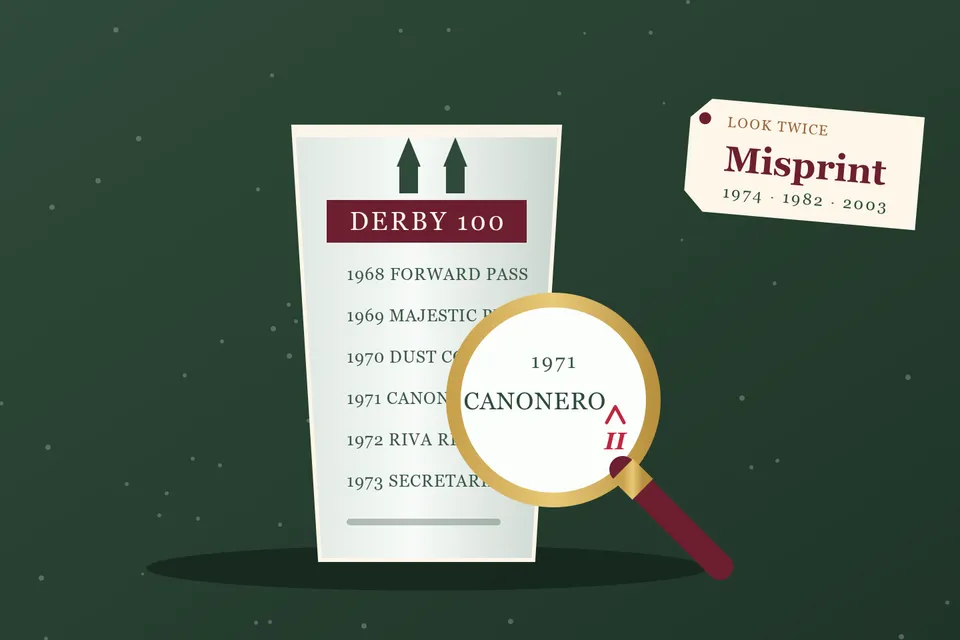
What is the most famous Kentucky Derby glass misprint?
The 2003 glass is the best-known modern one. According to the Associated Press, the first run of 100,440 glasses (about 20 percent of the total) marked 1932 winner Burgoo King as a Triple Crown winner and left the mark off 1937 Triple Crown winner War Admiral. Older errors include the 1974 glass that lists 1971 winner Canonero II as “Canonero” and 1982 and 1984 glasses missing the red dot that marks Genuine Risk as a filly.
In this story
Why a mistake can matter
Churchill Downs has made an official glass every year since 1938. The Kentucky Derby Museum says the tradition started almost by accident: the track’s dining-room water glasses kept going home with guests. Because so many are made, most years are common, and that is part of the fun of starting a collection.
Rarity comes from two places. The earliest glasses were made in small numbers (the museum calls the dated 1940 glass widely seen as the rarest). And from time to time, a production run comes out with an error or a variation. Those are the glasses collectors pick up and turn around.
Most Derby glasses print every past winner on the back. That list is where many of the mistakes hide.
The misprints and variations to know
1956: stars and tails
The Kentucky Derby Museum says a production error left the 1956 glass with a varying number of stars and horse tails. There are four versions, and the rarest has one star and three tails. Dealers also list a “headless jockey” version of the same year.
1958: the gold bar and the Iron Liege
The 1958 glass has two versions. The main one is the “gold bar” glass. The second was leftover 1957 stock, sold only in the infield, with “1957 Iron Liege” added along the top edge to name the previous winner. The museum calls the Iron Liege version the rarer of the two.
1974: Canonero without the “II”
The 1974 glass marked the 100th Derby. Its first run listed 1971 winner Canonero II as plain “Canonero.” A collector who runs the Horse Racing Memorabilia Museum site explains that more than 450,000 were made that way, then the whole run was redone with the correct name, so the error is about as common as the fix and adds little value on its own.
The version that matters is the glass maker. Libbey ran short of blanks and bought some from Federal, so a small number of 1974 glasses carry Federal’s mark on the bottom (with either spelling). Those Federal glasses are the hard ones to find. Look for the maker’s mark pressed into the base; it is faint, and some glasses show no mark at all.
1982 and 1984: Genuine Risk’s missing red dot
Derby glasses mark the fillies who won. In 1980, Genuine Risk became the second filly to win the Derby. The Associated Press reported that some 1982 and 1984 glasses failed to mark her as a filly. Dealers call these the “red dot missing” glasses, and collector price guides value them well above the regular 1982 and 1984 glasses.
1986: the wrong copyright year
Look at the small copyright line on the 1986 glass, the year Ferdinand and 54-year-old Bill Shoemaker won. Some read ©1985, the year before, and others the corrected ©1986. Collector price guides list both.
2003: Burgoo King’s Triple Crown that never was
This one made the news. In October 2002, Churchill Downs said the first 100,440 glasses for the 129th Derby, about 20 percent of the year’s production, marked 1932 winner Burgoo King as a Triple Crown winner and left the mark off War Admiral, who actually won the Triple Crown in 1937. “It’s Christmas morning for those who collect them,” track spokesman John Asher told the AP. A corrected glass followed, and the Derby Museum notes that some buyers rushed to stock up on the error version. The 2003 glass was Funny Cide’s year.
Other variations dealers list
Derby Glass Warehouse, a dealer that keeps a “mistake and variation” section, also lists these. They are worth knowing, but we found them described only in dealer listings, so treat them as a checklist, not a price guide:
- 1949: a version missing the words “year” and “name” at the top.
- 1973: a white-background version, instead of the usual frosted look, in Secretariat’s year.
- 1980: a dark brown version and a “green screen” version with no brown at all.
- 1999: a version with a white rose.
- 2009: one version with an all-black inside background and one with the “135” showing through.
Reproductions are not misprints
Some look-alikes are not mistakes at all. Churchill Downs has handed out promotional glasses, such as a 1957 reproduction and a 2006 glass featuring Secretariat’s track record, according to the same dealer. And the Equillector price guide warns about fake 1945 tall glasses made in the mid-1990s: the logo is darker and slightly smaller, and the “Kentucky Derby” lettering lines up differently with the horseshoe’s nail holes.
How to check a glass before you buy
- Read the back. Most errors are in the list of past winners. Look for missing suffixes, missing filly marks and Triple Crown marks in the wrong place. Our Derby winners by year list helps you check, and the Derby glossary covers the terms.
- Tip it over. The maker’s mark on the base matters for 1974. Use a flashlight at an angle.
- Check the small print. The copyright year is the tell on 1986.
- Ask for clear photos. Online, ask for the front, the back, the base and the rim. Our tips on photographing a glass collection work for sellers too.
- Check condition. Chips, cracks and faded printing matter more than most variations. Wash older glasses by hand.
- Be wary of big claims. A common error, like a 1974 “Canonero” on a Libbey glass, is not a rare find. If a listing calls a glass rare, ask which variation it is and compare it with the descriptions above.
Prices for errors move with collector demand, so we do not quote them here. For context, the AP reported in 2002 that the Burgoo King glasses, which retailed for $2 to $3, had sold for as much as $35.99 on eBay within days. Check recent sold listings before you pay a premium.
Start with the glass that matters to you
The best Derby glass is usually not the rarest. It is the one from a birth year, a wedding year or a first Derby. See a Derby glass for a milestone year, browse every Derby glass by year, or read about Nyquist and the 2016 glass. And if you will actually drink from it this spring, here is our mint julep recipe.
Sources
- Associated Press via ESPN: Mistake on Derby glasses creates instant collectible, Oct. 30, 2002 ↗
- Kentucky Derby Museum: The official mint julep glass, what makes something collectible? ↗
- Horse Racing Memorabilia Museum: the six variations of the 1974 Derby glass ↗
- The Equillector: Kentucky Derby julep glassware price guide (variations and the fake 1945 tall glass) ↗
- Derby Glass Warehouse: mistake and variation Kentucky Derby glasses ↗
Questions, answered.
Which Kentucky Derby glasses have misprints?
The best-known are 1974 (1971 winner Canonero II listed as “Canonero”), 1982 and 1984 (some missing the red dot that marks filly Genuine Risk) and 2003 (Burgoo King marked as a Triple Crown winner instead of War Admiral). The 1956 glass also has four star-and-tail variations, and some 1986 glasses carry a ©1985 copyright.
Is the 1974 “Canonero” Derby glass rare?
Not on its own. More than 450,000 were made with the error and about as many with the correct “Canonero II,” so collectors value them similarly. The scarce 1974 glasses are the ones made on Federal blanks, marked on the base.
How many 2003 Derby glasses had the Burgoo King mistake?
100,440, about 20 percent of the 2003 production, according to Churchill Downs as reported by the Associated Press in October 2002.
What is the rarest Kentucky Derby glass?
The Kentucky Derby Museum says the dated 1940 glass is widely seen as the rarest official glass. Early glasses were made in much smaller numbers than modern ones.
How can I tell if a Derby glass is a fake?
Compare it with a known original. The Equillector guide notes that fake 1945 tall glasses from the mid-1990s have a darker, slightly smaller logo and “Kentucky Derby” lettering that lines up differently with the horseshoe’s nail holes. When in doubt, ask a specialist dealer.
An independent editorial guide. Product purchases take place at A Taste of Kentucky.